
Journal of Development Research

 Search
Dimple Sukhija1, Pooja Srivastava2 , Anuradha Pathak1 and Palak Sukhija3
1 Indore Institute of Management and Research, Indore, Madhya Pradesh, India
2 Jain Online, Bengaluru, Karnataka, India
3 Shri Vaishnav Vidyapeeth Vishwavidyalaya, Indore, Madhya Pradesh, India

Creative Commons Non Commercial CC BY-NC: This article is distributed under the terms of the Creative Commons Attribution-NonCommercial 4.0 License (http://www.creativecommons.org/licenses/by-nc/4.0/) which permits non-Commercial use, reproduction and distribution of the work without further permission provided the original work is attributed.
The term ‘fear of missing out’ (FoMO) describes the uneasy sensations that surface when you realise that you might be losing out on fulfilling experiences that other people are enjoying. One intra-personal characteristic that encourages people to monitor what others are doing, especially on social media, is called FoMO. The COVID-19 pandemic-induced forced isolation had a significant negative influence on people’s well-being by decreasing opportunities for social interactions. As a result, people were using social media more frequently to stay in touch with others. In fact, FoMO may intensify people’s need to maintain social connections and engage in communication with others, which may result in persistent social networking (PSN) as a means of overcoming the fear of becoming invisible on social media when one is physically isolated. In this investigation, during the COVID-19 pandemic, a one-way ANOVA test was used to determine the impact of gender on FoMO. The empirical results prioritise the impact of gender and also assist academics in understanding the potential future scope. The study’s primary data were gathered using a self-structured, self-administered questionnaire with 33 valid items. Statistical Package of Social Science (SPSS 21.0) and Microsoft Excel 2007 were used to analyse the collected data and produce a valid conclusion.
COVID-19, fear of missing out, social media, online communication attitude, problematic social networking sites use, pandemic, lockdown
Introduction
The fear of missing out (FoMO) refers to the sensation or belief that other people are enjoying themselves more, having a better life or going through better experiences than you are. It has a detrimental effect on self-esteem and is typified by intense jealousy. The issue gets worse on social media sites like Facebook and Instagram. The sensation that you are missing out on something essentially important that other people are currently enjoying is known as FoMO. It goes beyond the notion that there are more worthwhile activities for you to do at this time. It may be anything, like a job advancement or a Friday night party, but it always entails a hopeless sense that you are losing out on something important.
Numerous difficulties have been brought up by the COVID-19 epidemic. Mental health concerns are the most urgent causes of concern among these obstacles. One such mental health issue that has been more prevalent since the pandemic’s start is anxiety, according to statistics. There are many reasons behind these increased anxiety levels. Among the numerous causes of worry that people have identified are health issues and financial loss.
The COVID-19 restrictions increased people’s use of social media, and those who were suffering from FoMO attempted to control their anxieties by using excessive or problematic social networking sites (SNS). This was made better by their preexisting attitudes towards online communication, which may have been further strengthened by the particular social distancing situation. These results require attention because they appear to indicate that attitudes resembling online communication traits may be a risk factor for the misuse or abuse of social media if they are associated with a genuine feeling of social isolation and/or a fear of losing the chance to relate to and participate in the experiences of others.
When we talk about young children, we picture them playing outside, going to school, and hanging out with friends. But since the pandemic struck, kids of all ages have been spending more time in front of screens at home. Even if the government and education ministries have issued rules to limit screen usage, mental health issues are associated with online learning. Having access to an electronic gadget can be very stressful for older kids and college-bound students. There is a significant digital divide in India among different states. According to a recent article, only half of the students in the state of Maharashtra have access to online schooling (Fegert et al., 2020). Students have severe difficulties when they are unable to attend online classes because of a lack of electricity or an internet connection, as this interferes with their ability to complete assignments and even exams. The younger generation has also taken a more ‘relaxed’ stance towards COVID-19 since they do not think it is dangerous for people in their age range. They have thereby transgressed social rules on social distancing. The young person may experience the opposite outcome, becoming nervous as a result of spending extended amounts of time apart from friends and peers. This, popularly known by the youth, is called FoMO (O’Sullivan et al., 2021).
Review of Literature
The fear of missing out (FoMO) is defined as
A pervasive apprehension that others might be having rewarding experiences from which one is absent, FoMO is characterised by the desire to stay continually connected with what others are doing. For those who fear missing out, participation in social media may be especially attractive. (Boursier et al., 2020)
In fact, people’s demand for relatedness is satisfied by the online world, which provides the perfect setting for meeting their needs for social awareness and connection with others even in remote places (Casale & Flett, 2020). For this reason, some studies by Kargın et al. (2020) have concentrated on the connection between Internet addiction and FoMO. However, some argue that the term ‘Internet addiction’ is too general and ignores significant distinctions between different types of online activity (Starcevic & Aboujaoude, 2017; Starcevic & Billieux, 2017), which conversely, warrants specific and differentiated attention.
Blackwell et al. (2017) discovered that those with FoMO are more likely to spend excessive amounts of time online since social media makes it simple to connect with others and can boost one’s perception of social involvement, making it the perfect place for people to learn about others (Przybylski et al., 2013). Abel et al. (2016) assert that a person is a social being who values the thoughts and behaviours of others and the ways in which these reflect on them. People use social media to see what is happening in other people’s lives as the digital world gets more and more integrated into their daily lives (Abel et al., 2016). People can see what they are missing out on (a party, supper, etc.) thanks to their continual (digital) access to others, which has been shown to increase emotions of worry, unworthiness and discontent (Abel et al., 2016; Przybylski et al., 2013). After using social media, people frequently experience increased anxiety, irritability, feelings of inadequacy and low self-esteem (Abel et al., 2016). Adolescents are especially susceptible to FoMO because of their peer participation, social ties and interactions (Barry et al., 2017).
In this sense, FoMO is a kind of internet addiction that primarily affects kids and teenagers, according to Tomczyk and Selmanagic-Lizde (2018). People feel bad when their demands to be online and obtain information as a source of satisfaction are not satisfied. Twenty per cent of the teenagers in their study had FoMO symptoms, and 30% were at risk of developing an SNS addiction. Three internet usage and addiction predictions are mentioned by the authors (along with FoMO). Initially, they characterise the escapist drive as the wish to get away from psychological problems like loneliness and melancholy. The second reason is boredom, which refers to the lack of activities to occupy one’s free time. Lastly, there is the ‘up-to-date’ reason, which is wanting to remain informed about the actions of others and maintain relationships with friends, or look for new experiences.
Research Objective
The main objective of the present study is to study the effect of gender on the behaviour of FoMO.
Hypotheses
H1: There is no significant effect of gender on the behaviour of FoMO on personal.
H2: There is no significant effect of the gender on behaviour of FoMO on social.
H3: There is no significant effect of the gender on behaviour of FoMO on novelty seeking.
H4: There is no significant effect of gender on the behaviour of FoMO on consumer susceptibility.
H5: There is no significant effect of gender on the behaviour of FoMO on social usage.
Research Methodology
The Study
The study is of an exploratory character and is predicated on a survey of Gen-X, Gen-Z and millennial viewers. Its goal is to investigate FoMO in millennials, Gen-Xers and Gen-Zers.
The Sample
The population being studied consists of current members of Gen-X, Gen-Z and millennial audiences. In the current investigation, samples from the population were chosen using non-probability judgmental sampling in the absence of a sampling frame. A handful of thoughtful respondents received invitations via e-mail to complete the questionnaire, and they were asked to pass it to other people who shared their profiles. The questionnaire was also completed using social media sites. The study’s sample came from a variety of Indian cities. Ultimately, out of the 500 intended respondents, 420 completed the survey satisfactorily.
Tools for Data Collection
The primary data for the study have been collected through a self-structured and self-administered questionnaire comprising 33 valid items. Following a thorough examination of the literature, the researchers finalised 36 items, which were then forwarded to six judges/experts from academia and industry for the face validity process. The judges decided on 33 of the 36 items. These questions were asked of a sample of 420 respondents using a 5-point Likert scale that went from strongly agree (7) to strongly disagree (1). A different component of the questionnaire was used to gather general demographic data from the respondents.
Tools Applied for Data Analysis
Collected data was analysed using Statistical Package of Social Science (SPSS 21.0) and MS Excel 2007 to arrive at a meaningful conclusion. The reliability of the 33 items of the scale was determined by Cronbach’s alpha method. The reliability coefficient alpha (α) was found to be 0.953 showing high reliability of the 34-item scale (Table 1).
Results and Discussions
To fulfil the objective—the results and discussion are as follows:
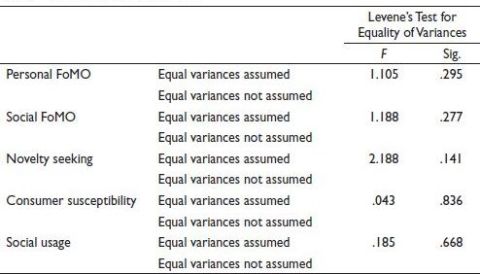
H1 is not rejected as the significance value is found as .295 which is more than .05, so no significant effect of gender was found on the behaviour of FoMO on personal (Table 3).
H2 is not rejected as the significance value is found as .277 which is more than .05, so no significant effect of gender was found on the behaviour of FoMO on social (Table 3).
H3 is not rejected as the significance value is found as .141 which is more than .05, so no significant effect of gender was found on the behaviour of FoMO on novelty seeking (Table 3).
H4 is not rejected as the significance value is found as .836 which is more than .05, so no significant effect of gender was found on the behaviour of FoMO on consumer susceptibility (Table 3).
H5 is not rejected as the significance value is found as .668 which is more than .05, so no significant effect of gender was found on the behaviour of FoMO on social usage (Table 3).
Table 1. Reliability Statistics.

Table 2. Details of Group Statistics.
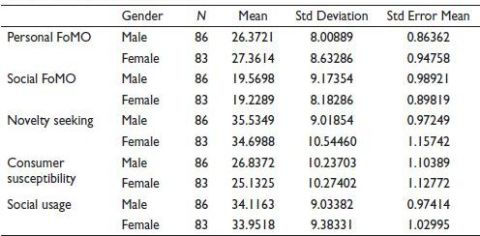
Table 3. Independent Sample T-test.
Discussions
Social media and digital tool usage have unavoidably increased as a result of the COVID-19 pandemic. We attempted to identify the causes of peoples’ encounters with FoMO that emerged from this usage of technology by conducting two investigations at the start and end of the epidemic.
Our findings show that people had FoMO during the epidemic, even if they were socially isolating themselves at home. There has been a significant change in the kind and volume of digital information people are consuming over this time. Our research indicates that the inability to keep up with real-time social media information, other people’s postings and videos, recently released films and television shows on streaming services like Netflix, and virtual get-togethers with loved ones are all common causes of FoMO (Table 2). Particularly, those with a higher propensity for FoMO as a personality trait reported experiencing it more strongly when it comes to digital information. We discover that akin to a vicious circle, greater virtual activity participation fuels higher degrees of FoMO, which in turn fuels further engagement.
Contrary to popular belief, there was no correlation found between the inability to keep up with the abundance of digital content and an individual’s extroversion or productivity orientation. Crucially, individuals exhibiting elevated trait levels of FoMO indicated a strong experience of FoMO throughout these online activities, throughout both the high point and subsequent phases of the outbreak. Even when the vaccination was made public and the limits were relaxed, there was no decrease in virtual FoMO, which may indicate that people were becoming accustomed to their highly digitalised ‘new normal’.
Conclusion
The global impact of the COVID-19 outbreak has disrupted daily lives worldwide, the challenges during the pandemic have been in distributing vaccines, and still aftermath challenges are impending. Despite vaccine availability, vaccine hesitancy persists in some regions, potentially prolonging the pandemic’s recovery. Identified as a significant threat by the World Health Organization, vaccine hesitancy posed a key risk to global health. Researchers and professionals are attentively determined to mitigate the pandemic’s adverse effects on individuals and society. Responding to urgent calls from various fields to investigate the pandemic’s impact on well-being, our study focuses on exploring how the FoMO influences individuals’ emotional and physical experiences amid increased exposure to digital content. As public health specialists refer to it, ‘quarantine fatigue’ is the outcome of staying inside to slow down the curve. In particular, a lot of individuals find it difficult to keep up with the plethora of virtual activities, which leads to a new type of FoMO that significantly impairs people’s happiness and well-being. It would seem reasonable to anticipate that during a time when people’s contacts and bodily motions are restricted, FoMO would be suppressed or even eliminated. However, we discover that instead of going away, FoMO has been replaced by an altered version of virtual FoMO which is associated with increased internet engagements, leading to significant health issues.
Future Directions for FoMO and Its Impact on Well-being
As individuals seek essential social connections amidst their current circumstances, turning away from digital and social media platforms, despite advice to do so, may prove challenging to execute. This relationship makes you more susceptible to FoMO. It would be interesting to investigate if social media activity, such as sharing and uploading content, as opposed to passive activity, such as browsing and staring at other people’s accounts, could lessen FoMO. Being in charge of and capable of keeping up with the current digital information may actually inspire thoughts of adequacy and provide a sense of respite from FoMO if one chooses to be a poster as opposed to a lurker.
Another way to reduce FoMO worry could be for people to start focusing more on themselves than on other people. It has long been demonstrated that mindfulness and meditation techniques improve subjective well-being by bringing people into the present. By cultivating an attentive awareness of the present, people might avoid focusing on other experiences that are going on at the same time. Likewise, JoMO (the joy of missing out) enjoying one’s current moment regardless of thinking about what others are doing is a term that has not been extensively academically researched and explored. Investigating the contextual elements and rewards that could spur delight in the moment—whether it be through digital or offline experiences while eschewing peer comparisons would be beneficial. As people go on to the next phase of the epidemic, a change from FoMO to JoMO may prove beneficial.
Declaration of Conflicting Interests
The authors declared no potential conflicts of interest with respect to the research, authorship and/or publication of this article.
Funding
The authors received no financial support for the research, authorship and/or publication of this article.
ORCID iD
Pooja Srivastava https://orcid.org/0000-0003-4495-1652
Abel, J. P., Buff, C. L., & Burr, S. A. (2016). Social media and the fear of missing out: Scale development and assessment. Journal of Business & Economics Research, 14(1), 33–44. https://doi.org/10.19030/jber.v14i1.9554
Barry, C. T., Sidoti, C. L., Briggs, S. M., Reiter, S. R., & Lindsey, R. A. (2017). Adolescent social media use and mental health from adolescent and parent perspectives. Journal of Adolescence, 61, 1–11. https://doi.org/10.1016/j.adolescence.2017.08.005
Blackwell, D., Leaman, C., Tramposch, R., Osborne, C., & Liss, M. (2017). Extraversion, neuroticism, attachment style and fear of missing out as predictors of social media use and addiction. Personality and Individual Differences, 116, 69–72. https://doi.org/10.1016/j.paid.2017.04.039
Boursier, V., Gioia, F., Musetti, A., & Schimmenti, A. (2020). Facing loneliness and anxiety during the COVID-19 isolation: The role of excessive social media use in a sample of Italian adults. Frontiers in Psychiatry, 11, 586222. https://doi.org/10.3389/fpsyt.2020.586222
Casale, S., & Flett, G. L. (2020). Interpersonally-based fears during the COVID-19 pandemic: Reflections on the fear of missing out and the fear of not mattering constructs. Clinical Neuropsychiatry, 17, 88–93. https://doi.org/10.36131/CN20200211
Fegert, J. M., Vitiello, B., Plener, P. L., & Clemens, V. (2020). Challenges and burden of the Coronavirus 2019 (COVID-19) pandemic for child and adolescent mental health: A narrative review to highlight clinical and research needs in the acute phase and the long return to normality. Child Adolescent Psychiatry Mental Health, 14, 20.
Kargin, M., Türkben P., H., & Şimşek, D. C. (2020). Evaluation of internet addiction and fear of missing out among nursing students. Perspectives in Psychiatric Care, 56, 726–731. https://doi.org/10.1111/ppc.12488
O’Sullivan, K., Clark, S., McGrane, A., Rock, N., Burke, L., Boyle, N., Joksimovic, N., & Marshall, K. (2021). A qualitative study of child and adolescent mental health during the COVID-19 pandemic in Ireland. International Journal of Environmental Research and Public Health, 18, 1062–1066.
Przybylski, A. K., Murayama, K., DeHaan, C. R., & Gladwell, V. (2013). Motivational, emotional, and behavioural correlates of fear of missing out. Computers in Human Behavior, 29(4), 1841–1848. https://doi.org/10.1016/j.chb.2013.02.014
Starcevic, V., & Aboujaoude, E. (2017). Internet addiction: Reappraisal of an increasingly inadequate concept. CNS Spectrums, 22, 7–13. https://doi.org/10.1017/S1092852915000863
Starcevic, V., & Billieux, J. (2017). Does the construct of internet addiction reflect a single entity or a spectrum of disorders? Clinical Neuropsychiatry, 14, 5–10.
Tomczyk, L., & Selmanagic-Lizde, E. (2018). Fear of missing out (FOMO) among youth in Bosnia and Herzegovina—Scale and selected mechanisms. Children and Youth Services Review, 88, 541–549. https://doi.org/10.1016/j.childyouth.2018.03.048
