
Journal of Development Research

 Search
Sangita Das1 and Amit Kundu2
1Department of Economics, Syamaprasad College, Kolkata, West Bengal, India
2Department of Economics, Jadavpur University, Kolkata, West Bengal, India

Creative Commons Non Commercial CC BY-NC: This article is distributed under the terms of the Creative Commons Attribution-NonCommercial 4.0 License (http://www.creativecommons.org/licenses/by-nc/4.0/) which permits non-Commercial use, reproduction and distribution of the work without further permission provided the original work is attributed.
This article investigates whether school-going children’s participation as ‘not directly paid’ family labourers in domestic chores and/or economic activities helps their families to improve their livelihood in rural West Bengal. The findings indicate that the likelihood of hidden child labour is greater when the child’s father is old, the child is not an infant, the household possesses positive operational assets and the child’s mother is part of a self-help group. Parental positive attitude towards their child’s education can also reduce the incidence of hidden child labour within the family. The evidence from the two-step treatment effect model further suggests that hidden child labour helped their family earn a higher family income than households without hidden child labour during the reference period.
Hidden child labour, rural households, probit regression, Heckman’s two-stage treatment effect model, livelihood
Introduction
Child labour is a complex and pervasive problem in India. Children between the ages of 5 and 14 are considered child labourers if they supplement their family’s income (Basu, 1999; Bhukuth, 2008). According to ILO (1998), a child (in the age group of 5–11 years) who is involved in any economic activity for at least 1 hour per week or an adolescent (in the age group of 12–14 years) who performs either non-hazardous work for at least 14 hours per week or hazardous work for 1 hour per week is defined as a child labourer. Since the 1980s, India has taken several initiatives to eliminate child labour. Policies such as the Child Labour Prohibition and Regulation Act (1986), the National Child Labour Policy (1988) and the International Programme on the Elimination of Child Labour (IPEC) in collaboration with ILO (1992), the Child Labour (Prohibition & Regulation) Amendment Act (2016) and Child Labour (Prohibition and Regulation) Amendment Rules (2017) were adopted mainly to prevent children below 14 years from engaging in in any type of paid job and adolescents (14–18 years) from hazardous occupations and processes. Rehabilitative measures have also been initiated for migrant child labourers through bridge education and pre-vocational training to mainstream the rescued children into the formal education system. Besides, the Right of Children to Free and Compulsory Education Act (2009) was also implemented to provide the right to education to all children, especially the poorer section of children, and protect them from working in hazardous activities and exploitation. All these measures were adopted to prevent full-time paid child labour. But Webbink et al. (2012) identified that many children (below the age of 14) in developing countries are not engaged in paid employment, but they help the family members with housework and family business work without directly getting any wage in terms of cash. They designated this type of labour as ‘Hidden Child Labour’.1 In this context, UNICEF (2006) defines child labourers as children engaged in domestic chores for four or more hours per day. Anker (2000) and Basu (2000) explained that although household work and childcare are not treated as child labour, long hours of these activities performed by children regularly create an obstacle to their school attendance and learning outcomes. Afridi et al. (2016) have shown that a mother’s participation in the labour force in rural households increases her children’s time spent in school and leads to better grade progression. Das (2022), based on the Periodic Labour Force Survey unit-level data, proved that children from economically disadvantaged families are more likely to engage in child labour. It is suggested that increasing children’s education attainment and providing financial assistance to poor families can effectively reduce the incidence of child labour. Mid-day meal programmes and almost free direct cost of education expenditure have already been implemented in India, and it has percolated into every corner of rural households all over India. Visibly, that has reduced the incidence of paid child labour in the economy. But Kundu and Goswami (2022), based on a household-level survey, identified the importance of the adult equivalent family labour force during the time of deciding leased-in land among the marginal farmer households of West Bengal, and the adult equivalent family labour force also plays a positive role in enhancing the agricultural income among those marginal farmer households. During the time of calculation of the adult equivalent family labour force, the children of the sample households who are engaged in farming were also considered. Those children are here described as ‘Hidden Child Labour’.
Generally, two types of hidden forms of child labourers are observed in poor households: (a) in family work, where children are involved mainly in agriculture and family enterprises, and (b) in housework or domestic chores that comprise childcare, cleaning, washing, cooking, carrying water and shopping among others. In these two types of activities, the work carried out by children remains unpaid and underreported (Putnick & Bornstein, 2016; Webbink et al., 2012). This type of ‘hidden form of child labour’ has the most vulnerable and marginalised backgrounds, with children experiencing the risk of deprivation in terms of their well-being and overall development. During income shock or health shock in a family, these domestic child labourers become the principal source of family income for the survival of the household, which then impedes their ability to attend classes and fully participate in school activities including games and sports (Galli, 2001; Ravallion & Wodon, 2000). This article will try to explore which situation and under what circumstances adult family members involve their children in unpaid economic activities within the family. Here ‘Hidden Child Labour’ is defined as a type of child labourer (a) who is directly engaged in a household activity and (b) works as unpaid labour in their family business.
The second section reviews the existing literature to identify the research gaps. The third and fourth sections outline research objectives, data sources, sample design and data analysis. Based on the field investigation, the fifth section uses the probit model to assess possible household-related factors responsible for the existence of ‘Hidden Child Labour’ within rural poor families. The sixth section examines whether these child labourers contribute to improved family livelihood in these households. The seventh section provides the conclusion, and research limitations and future scope of research are presented in the eighth section.
Literature Review
A hidden child labourer works as an unpaid labourer regularly either in households, on the family farm or in family enterprises (outside the mainstream paid work) (Bullen, 1986; Webbink et al., 2012). The domestic workforce participation of children depends on the parental decisions of the trade-off between cost (foregone costs of schooling such as expenditure of school fees, school uniform and books among others) and benefit (income derived from working in a family farm or business or involving other earning activities) analysis (Woldehanna et al., 2008). The determinants such as low level of per capita income of the family, landlessness, parental attitude towards a child’s work and lack of availability of institutional credit, male-dominated households and less accessibility of social capital are the vital factors for children’s time allocation on educational attainment, household work involvement and leisure activities (Basu, 1999; Burki et al., 1998; Goswami & Jain, 2006). When a mother of a poor household engages herself as a wage labourer, there is less possibility for a girl child to attend school as she performs all the domestic chores (Bhalotra, 2007). Galli (2001) found that the participation of children in hazardous or non-hazardous work or as a paid or unpaid family labourer is crucial to meet the subsistence standard of living when a household suffers from any risk of inadequate productivity or shock of adult joblessness. Using the household survey data (1996) of Brazil, Emerson and Souza (2003) observed that children hardly work as family labourers if the household income and parental education are high.
Based on the Ghana Living Standards Survey (1987–1992) and ILO Child Labour Survey (1996), Canagarajah and Coulombe (1997) investigated the relationship between the probability of school attendance and working children in households. The multinomial logit model shows that school participation enhances children’s welfare but imposes an extra financial burden on poor families. Based on data from the Egypt Market Survey, Sakamoto (2006) captured the parental attitudes by their decision towards the well-being of their children. The high cost of school education and the greater bargaining power of the father in the family significantly influenced the household decision towards children’s involvement in work. Using the World Bank survey data for rural Ghana and Pakistan, Bhalotra and Heady (2003) estimated that nearly 50% of school children (7–14 years old) engage in housework, and only 7% of working children can attend school regularly. Udry (2006) opined that the poor functioning of the financial market and the difference between the immediate benefit from education and the long-term cost of children’s school education are the key factors to increase the incidence of hidden child labour among poor households. Ravallion and Wodon (2000) studied the combined effect of enrolment subsidy on children’s schooling and household working time in rural Bangladesh. Subsidised school education lessens unpaid domestic child labour and increases school enrolment. Guarcello et al. (2010) assessed whether income risk and vulnerability of the households have an impact on children’s unpaid work participation and schooling decisions. Their study reveals that credit rationing helps to increase household income, which boosts investment in human capital for children’s development. Bhalotra and Heady (2003) and Basu et al. (2010) explained the wealth paradox that the relationship between land ownership of a household and unpaid domestic child labour is an inverted U-shape; that is, the labour force does not monotonically decline with the increase in land. Bandara et al. (2014) analysed the impact of income shock (agricultural shock) and non-income shock (parental death) on family child labour. The study reveals that crop shock enhances children’s work and responsibility for domestic chores and agriculture, whereas sudden parental death raises their family liability.
India has already banned ‘child labour’. It has kept the direct cost of education almost zero at the elementary and post-primary levels. The mid-day meal programme was also initiated, which has spread in all parts of rural India (Biswas & Kundu, 2021). But still today, sometimes the prevalence of a child working as a family labour force is observed in rural West Bengal. This article wants to investigate possible reasons behind this and will also investigate whether the existence of a hidden form of unpaid child labour can give economic benefit to the household or not.
Research Objectives
Although numerous research papers have focused on the determinants of child labour and its policy measures, attention has not been paid to the existence of a daily unpaid hidden child workforce among rural families. The conventional methods for measuring the incidence of child labour often ignore the school children’s work participation in domestic chores and/or economic activities as domestic workers for long hours daily during their late childhood (6–12 years) to early adolescence (12–14 years). In the research papers, ‘Hidden Child Labourers’ are in the age group of 6–14 years who are pursuing school education as well as supporting their adult family members physically by working as ‘not directly paid’ family labourers. The research objective is to investigate whether a child’s participation in hidden child labour within the household even after attending school significantly contributes to their family income. To investigate that we have to take the help of a ‘field experiment’ where initially it is required to identify the socio-economic factors which prompt a household to engage its child in hidden child labour.
Sample Design and Field Investigation
The field experiment was conducted in the district of Purba Medinipur of West Bengal. Out of 25 blocks of the district, the Bhagawanpur-1 block was chosen, which is not only the biggest block but also one of the economically backward blocks. Based on the Human Poverty Index (Sen & Anand, 1994), the incidence of poverty in this block is shown at 27.81% (Census of India, 2011). As per the Census of India (2001), the district has contributed 4.1% of child labour of the total child labour of West Bengal.
Among the 10 Gram Panchayats (GPs) of the block, two large GPs of the district—Mahammadpur-I and Mahammadpur-II—were considered for our investigation. Nine out of 22 villages of these two GPs were selected randomly. The survey was conducted among the rural households who are landless2 and marginal landholders3 (up to 1 bigha4 operational landholdings). According to the definition of ‘Hidden Child Labour’, the labourers are engaged only as a ‘not directly paid’ family labour force (Webbink et al., 2012). As per Kundu and Das (2022a), a significant portion of marginal farmers and landless agricultural labour households are economically poor. Consequently, the existence of ‘Hidden Child Labour’ is anticipated within these households. Target households are first identified from the information of local people, GP and teachers and students of primary and secondary schools, and an approximate number of rural households having children (6–14 years) are obtained in the reference period (past 60 days from the point of data collection). Finally, sample households were drawn randomly from the above-mentioned households.
To address the research questions in the study, a well-structured questionnaire was constructed based on the pilot survey in two villages of Mahammadpur GP-1 of Bhagawanpur block. After eliminating the irrelevant data, missing data and duplicate data, the final sample size became 380 households,5 which were categorised into two groups:
Out of 380 sample households, 353 have at least one child aged 6–14, with 161 girls and 192 boys in this age group.6 Face-to-face interviews were conducted with the respondents to gather information on demographic characteristics related to family income, parental education, employment, health, family wealth and credit facilities. Specific questions were also asked about the children’s activities during the reference year, including the nature and duration of their work, as well as their current school attendance status. Additionally, information was collected from the sample children regarding the time they sacrificed for work as ‘Hidden Child Labour’.
This field experiment was conducted between April and May 2019. Therefore, the reference period for the primary survey was from April 2018 to March 2019.
Here, initially, the probit regression is used to identify the possible household-related factors which are responsible for the existence of ‘Hidden Child Labour’ among sample rural households. Probit is considered here because the dependent variable is binary. Next, it is required to investigate whether there exists any economic benefit to the rural households that engage their children in domestic, not directly paid economic activity. To do that, the Heckman’s Treatment effect model is adopted. Here, the considered outcome variable is the average monthly income of the household. In this context of regression analysis, the outcome variable is assumed to follow the normal distribution. The challenge is to censor normal distribution, which is observed here. In this situation, the key factor is the inverse Mills’ ratio, which is considered as a hazard factor and denoted as λ here. Heckman’s sample selection model uses λ to estimate the outcome variable. It is also used to tackle the problem of sample selection bias, which is very important in a field experiment. Here, the outcome variable is observed both for the treatment group (the households where the existence of hidden child labour is observed) and for the control group (the sample households where there is no existence of hidden child labour). As the treatment variable in this field experiment is the existence of hidden child labour in the sample household, which itself is endogenous, the two-step treatment effect model is appropriate for this investigation.
Data Analysis
Table 1 presents the distribution of 353 sample children concerning their education and work status within their households. These children are divided into two categories, as mentioned in the table. We primarily focus on the second category of rural households, where 177 school-aged children are identified as ‘Hidden Child Labour’. They assist other earning members of the family in economic activities and/or performing domestic activities to support their mothers each day beyond school hours. Among these 177 ‘Hidden Child Labourers’, 98 are boys and 79 are girls. Field surveys revealed that both boys and girls in this category devote at least 2–3 hours (outside their school hours) to domestic chores or other income-generating activities for the economic benefit of their families.
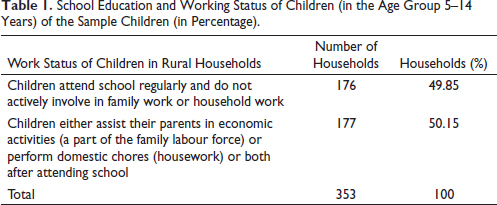
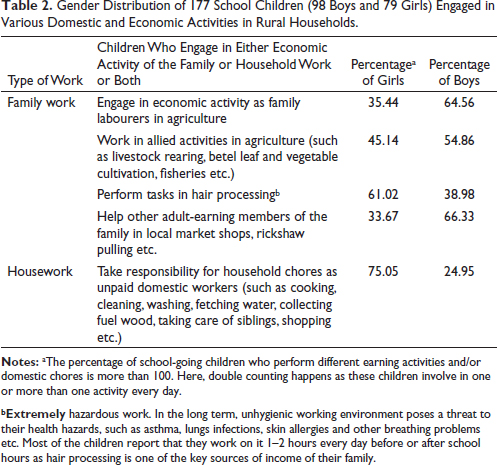
Table 2 displays the gender-specific distribution of work types for our sample ‘Hidden Child Labourers’. Female children are primarily engaged in housework and hair processing, while male child labourers are involved in farm-related and market work.
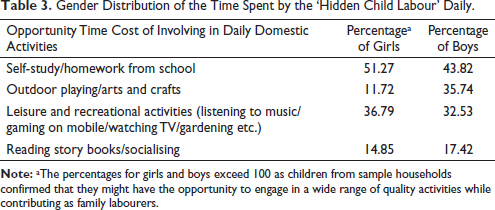
Table 3 outlines the daily home-based work (family and house-related tasks) carried out by 177 children aged 6–14 years and their associated opportunity time spent on these tasks. Approximately 51% of girls and 44% of boys reported that their engagement in home-based activities came at the expense of their self-study or homework time. Similarly, nearly 37% of girls and 33% of boys mentioned that they sacrificed their leisure and recreation time including game time to engage in allied activities. Additionally, they mentioned that the average duration of family work per day during the reference year was approximately 2–3 hours or even longer, beyond their school hours. According to the Parliamentary Standing Committee on Labour (2013–2014), engaging school-going children in domestic chores could potentially hinder their academic progress, as leisure and recreational activities are essential for developing both their mental and physical well-being (George & Panda, 2015).
Identification of Causes Behind the Existence of Hidden Child Labour in Rural Households
To identify the causes behind the existence of hidden child labourers among rural households, we consider a set of potential key factors and provide their explanation with appropriate theoretical justifications below.
1. Caste of the ith households (Castei): The incidence of child labour is observed more in the socially backward (such as SC, ST and OBC) households as they experience a higher incidence of poverty than the upper caste households (Goswami & Jain, 2006). Therefore, it is required to examine whether caste is a responsible determinant for hidden child labour.
2. The gender of children of the ith households (Genderi): It is required to investigate whether poor rural parents prefer a girl child over a boy in family (or household)-related work or not. It is treated as a dummy variable and takes the value 1 if the sample ‘Hidden Labour’ is a girl and value 0 if it is a boy.
3. Children’s age in the ith households (Cagei): It is expected that children’s work participation in poor families may enhance with the increase in their age (Cockburn & Dostie, 2007; Webbink et al., 2012). Hence, older children might take higher work responsibility by assisting adult members in the households and contributing to the family income indirectly.
4. The father’s age in the ith households (Fagei): An elderly father may not be able to earn sufficient income to meet minimum family expenses. Adolescents (10–14 years old) are sometimes obliged to help their fathers in diversified farm and non-farm activities.
5. The total number of members in the ith households (HHsizei): A greater number of household members are expected to be involved in several earning activities which help to increase the household’s income and lessen the domestic work burden on school-going children (Sakamoto, 2006).
6. The father’s education in the ith households (Fedui): Educated fathers always want to educate their children as they know the value of schooling and higher expected returns from education in future (Mukherjee & Das, 2008).
7. The mother’s education in the ith households (Medui): An educated mother’s greater bargaining power influences the household’s decision positively to invest more money in a child’s education (Emerson & Souza, 2003).
8. Parental attitudes in the ith households (Pattitudei): Sakamoto (2006) considers parental concerns towards the educational attainment of children. Parental attitude is captured by the ratio of annual money spent on children’s education to the annual family income. The higher value indicates that parents want to augment healthy and productive lives by increasing children’s quality education by reducing their work engagement within and outside the family and investing in human capital to become better-paid skilled workers in their adulthood (Burki et al., 1998; Webbink et al., 2012).
9. The total number of unemployed days of a father (Unemplydysi): It is measured by the total number of person-days of the father (or the main earning member of the household), who remains unemployed in the entire reference year. It is expected that the possibility of participation of a child as hidden child labour will be higher if their father (or the main earning member of the household) remains unemployed for more person-days in the entire reference period.
10. Health expenditure of the family (Hexpi): The higher average monthly health expenditure of the family possibly increases the domestic work burden on the children.
11. Possession of operational landholdings (in decimal) by the ith households (Opelandi): The relationship between work participation of children and the household’s wealth might be non-linear as child labour increases with the increase in a household’s possession of landholdings first and then it declines (Basu et al., 2010; Webbink et al., 2012). On the contrary, Bhalotra and Heady (2003) show the ‘wealth paradox’—children are more involved as family labourers in households with possession of land and livestock. In this context, this study examines whether children belonging to families with operational landholdings (owned and leased-in land) increase their work burden as hiring a labour is very expensive at the harvesting time (Woldehanna et al., 2008).
12. The mother’s membership in a self-help group (SHGi): Higher accessibility of microcredit of the household raises the domestic work burden on the child as the mother and adult members of the family are engaged in household enterprises (Hazarika & Sarangi, 2008). Hence, it is important to examine whether mothers’ membership in self-help groups creates any impact on the incidence of hidden child labour in rural families.
13. Accessibility of institutional credit of the ith households (Inscrediti): Less accessibility to formal loans could be a critical factor in the prevalence of hidden child labour. Due to restrictions of collateral, poor families are unable to receive institutional credit, which is a constraint either to invest in making any income opportunities or to offset any income shocks that may enhance children’s domestic responsibilities (Beegle et al., 2003; Ranjan, 2001).
During the selection of rural households, only poor marginal farmers and landless agricultural labour households were chosen, as they rely on labour-intensive, diversified occupations for survival (Kundu & Das, 2022b). These households are aware of the ‘ban on child labour’ and cannot send their children to the job market to supplement family income (Basu, 1999). However, some of them involve their children in domestic economic activities due to the need for an additional family labour force. Hence, in this investigation, the ‘income of the household’ cannot be treated as a major cause behind the existence of ‘Hidden Child Labour’.
The outcome variable, ‘Hidden Child Labour (ICL)’, is binary, and takes the value 1 if the sample child worked as ‘Hidden Child Labour’ in the reference period and 0 otherwise. The probit regression equation is expressed as follows:

Before going to the probit regression analysis, we examine the multi-collinearity problem among the explanatory variables. The variance inflationary factor  values show that the two three of explanatory variables—(a) possession of operational landholdings (Opeland), (b) accessibility of institutional credit (Inscredit) and (c) parental attitudes towards the children’s education (Pattitude) and parental education (Fedu and Medu)—suffer from the multi-collinearity problem as their values are more than 4. To reduce the multi-collinearity problem among the mentioned explanatory variables, we have applied two separate probit regression models as follows:


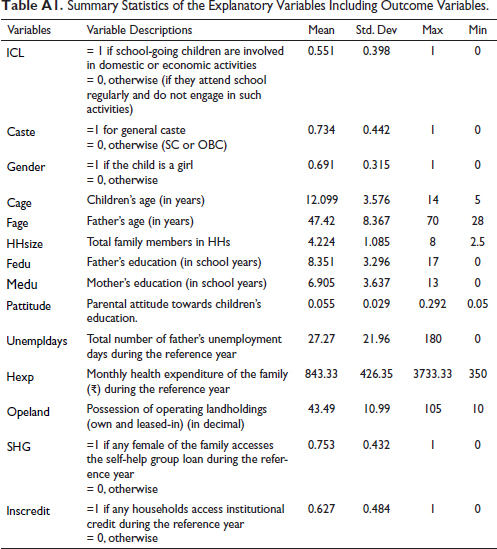
The summary statistics of the explanatory variables and the dependent variable considered in Equation (1) are described in Table A1 in Appendix A.
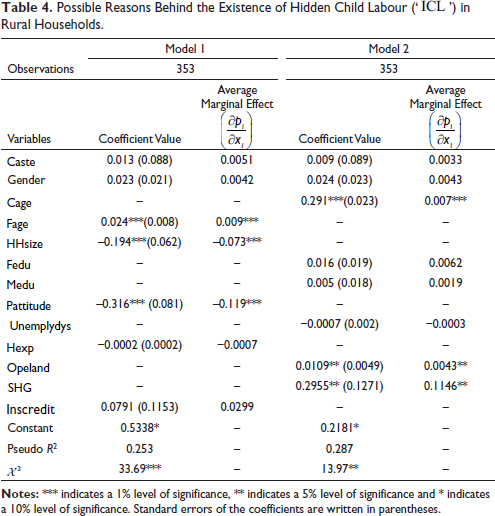
The results of the probit model mentioned in Equations (2) and (3) are presented in Table 4.
Discussion
Table 4 shows that sometimes children are compelled to take responsibility for family work due to their ageing father. The possibility of putting domestic work burden on children increases with their increasing age. Higher operative (owned and leased-in) land increases the possibility of the children of that farm household to be considered as a member of family labourers, especially during the harvesting seasons. In our analysis, the size of cultivatable land including the leased-in land is associated with a higher incidence of hidden child labour. This phenomenon is known as the ‘wealth paradox’ (Bhalotra & Heady, 2003). If farm households, particularly those with marginal farmers, experience a substantial labour demand during the harvest season, they may engage their children, particularly boys, to augment the family workforce. This can give rise to the potential presence of ‘Hidden Child Labour’. Our evidence further illustrates that especially the possibility of a ‘hidden form of child labour’ increases if the mother is an SHG member.7 Here, the dominance of girl children is observed who directly help their mothers in income-generating activities through devoting their time in labour. This possibly allows their mothers to participate in self-employment opportunities after getting micro-credit for income-generating activities from self-help groups (Galli, 2001; Rosenzweig, 1977). The total absence of gender preference is observed among rural poor families during the time of engaging them in any type of economic activity within the family. But the factor which can mostly reduce the incidence of ‘Hidden Child Labour’ is positive parental attitude, that is, spending more on human capital accumulation for their children.
Why Do Some Parents Want to Engage Their Children in ‘Hidden Child Labour’?
It has been proven that the engagement of a child in ‘Hidden Child Labour’ is endogenous. We now aim to explore whether there exists any economic benefit for the families who engage their children in ‘Hidden Child Labour’. To investigate this, the average monthly family income of the sample households (AMIH) is considered as the outcome variable, which serves as a proxy for livelihood. To calculate the annual income of the sample households, initially, the field study captured the information regarding the earning details of each working member of the family from diverse activities in the farm and non-farm sectors (Kundu & Das, 2022b) during the entire reference period, average annual savings (institutional as well as non-institutional banks) and the amount of money needed to repay their loans with the rate of interest during the reference period (from April 2018 to March 2019). The net annual income of the households can be obtained by subtracting annual savings and the amount spent for repayment of loans during the entire reference period from the total annual income of the households. Dividing that by 12 one can get the average monthly income of a sample household.
The outcome variable is the average monthly income of the household, and it is calculated among the households where ‘Hidden Child Labour’ is present and the sample households where it is not present. The first type of rural household belongs to the ‘treatment group’, and the second type belongs to the ‘control group’.
In this context, the existence of ‘Hidden Child Labour’ within the sample of rural households is regarded as an ‘intervention’. However, other potential control factors that may play an important role in enhancing the livelihood of rural households are described below with theoretical justifications.
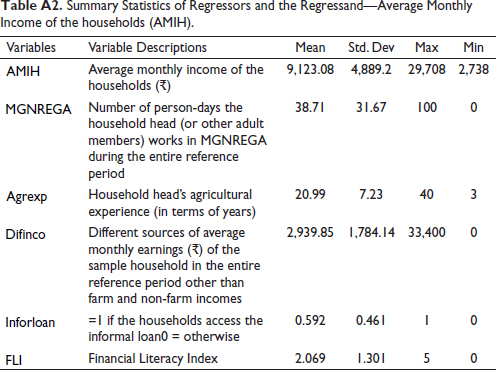
Now, the summary statistics of explanatory variables in Equation (5) and the outcome variable, AMIH, are described in Table A2 in Appendix B.
In this field experiment, the two-stage treatment effect model by Heckman (1979) is used to address sample selection bias and endogeneity issues associated with the presence of ICL. Heckman’s two-step treatment effect model has been applied in this field experiment. For Heckman corrections in our study, we consider the original and selection equations in the model.
The original equation can be written as follows:

Where AMIHi represents the average monthly income of all types of sample households. The original equation can be expressed as follows:

Equation (5) is the prime equation, and mainly its parameter estimation of ‘ICL’ is important to understand whether children’s participation in economic activities and domestic work as family labourers truly helps to improve the living standard of rural households by generating extra family income. There are a few possible factors which are responsible for the existence of ‘Hidden Child Labour’ in the sample households. All possible factors are mentioned in the selection equation.
To investigate the possible determinants of hidden (or domestic) child labourers in rural households, the selection equation (considered as a proxy of intervention) expressed in Equation (6) will be estimated by the probit regression equation:

Now we rewrite Equation (5), which contains the original explanatory variables as well as an additional explanatory variable, known as the inverse Mill’s ratio,  , predicted from the estimated co-efficient of the selection Equation (6), which can be described as follows:

Where ρ is the correlation between two errors terms10—unobserved determinants of hidden child labour (ε) in Equation (6) and unobserved determinants of average monthly income of the households (u) in Equation (5)—and σu is the standard deviation of u and σu>0, and the parameter estimator of is .
Equation (7) illustrates that sample selection can suffer from the omitted variable bias, as conditional on both X and . Hence, Equation (7) can be estimated by substituting
  from the probit estimates from the selection Equation (6) and then constructing the
  term and using it as an additional explanatory variable. If
  , the coefficient on is also equal to 0, showing that the null hypothesis is accepted, explaining that there is no existence of selectivity bias in the investigation and the problem can be addressed with the help of simple OLS (ordinary least square) analysis.
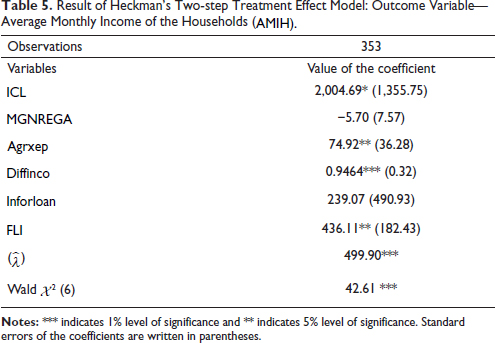
To investigate whether the presence of ‘Hidden Child Labour’ can help the rural households to improve their livelihood, the two-step treatment effect model is here applied, whose result is presented in Table 5.
Discussion
Table A2 shows that the application of Heckman’s two-step treatment effect model in this field experiment is appropriate as the parameter estimate of is positive and statistically significant. If the average monthly income of the rural household (AMIH) is considered an indicator of its livelihood, after correcting the selectivity bias, it is proven that the existence of hidden child labour helps families to maintain a better livelihood than the families where it is absent. It explains that the existence of hidden child labour can substantially increase the family labour force through participating in domestic activities and/or contributing to the household’s income-generating activities. Sacrificing their leisure, playtime or study time, they help their parents do household work so that the mother or father or both can have some benefit of time, which can help them engage in other economic activities or give them some physical rest. Hidden child labourers are not school dropouts. They attend their schools regularly. But still, they work as unpaid family labour in their households. Their active working hours directly or indirectly serve as a means of supplementary income for the family by reducing wage-related costs. This additional income plays a vital role in making ends meet and covering unforeseen financial demands. Though this micro-level study has been done in rural West Bengal, still it can be observed in other parts of West Bengal and India. This article establishes the economic importance of hidden child labour among poor rural households, and surprisingly, no possible policy prescription can be suggested to remove it. The study further exhibits that different sources of income other than farm and non-farm earnings of the family, the agricultural experience of the household heads and the financial literacy of the adult members of the households also play an important role in enhancing the livelihood of the sample rural households.
Conclusion
This article examines the determinants of the existence of hidden child labour among rural labour households and its impact on family income and livelihood. It is observed that a larger family size reduces the child’s domestic work burden, while older children are more likely to be involved in such tasks. Young fathers or household heads are willing to participate in a diverse set of farm and non-farm activities that smoothen their consumption by lowering income shocks and helping to reduce the incidence of hidden child labour within the households. Accessibility of micro-credit through self-help groups creates self-employment opportunities that raise the household workload on children as mothers are engaged in the family business or self-employment activities. But the existence of such ‘hidden child labour’ can be reduced if the parents give more importance to human capital accumulation for their children. The evidence from the two-step treatment effect model developed by Heckman further suggests that families with the presence of hidden child labour can have a better livelihood than the families where it is absent. However, other factors such as the different sources of earnings, the agricultural experience of a father and financial literacy among the household members also have a positive impact on the livelihood of all types of rural households.
Limitations and Further Scope of Research
This article is a micro-level study. Though this research objective is still not addressed properly in the Indian context, this type of unpaid child labour is observed among rural households in different parts of India. It is required to investigate whether the parents prefer their girl children to engage in unpaid domestic work over their boys or not. An inter-state comparison can be done in this area because the socio-economic and cultural beliefs among rural people in a patriarchal society like India are different. It can be done using NSSO’s Time Use Survey.
Appendix A: Summary Statistics of the Variables in Equation (1)
Appendix B: Summary Statistics of the Variables in Equation (5)
Declaration of Conflicting Interests
The authors declared no potential conflicts of interest with respect to the research, authorship and/or publication of this article.
Funding
The authors received no financial support for the research, authorship and/or publication of this article.
Notes
ORCID iDs
Sangita Das https://orcid.org/0000-0003-0109-1955
Amit Kundu https://orcid.org/0000-0001-7879-5243
Afridi, F., Mukhopadhay, A., & Sahoo, S. (2016). Female labour force participation and child education in India: Evidence from the national rural employment guarantee scheme. IZA Journal of Labour and Development, 7, 2–27.
Anker, R. (2000). The economics of child labour: A framework for measurement. International Labour Review, 139, 257–265.
Assaad, R., Levison, D., & Zibani, N. (2010). The effect of domestic work on girls’ schooling: Evidence from Egypt. Feminist Economics, 16(1), 79–128.
Bandara, A., Dehejia, R., & Lavie, S. (2014). Impact of income and non-income shocks on child labour. World Institute for Development Economics Research, United Nations University.
Basu, K. (1999). Child labor: Cause, consequence, and cure, with remarks on international labour standards. Journal of Economic Literature, 37(3), 1083–1119.
Basu, K. (2000). The intriguing relation between adult minimum wage and child labour. The Economic Journal, 110(462), C50–C61.
Bhalotra, S. (2007). Is child work necessary? Oxford Bulletin of Economics and Statistics, 69(1), 29–55.
Bhalotra, S., & Heady, C. (2003). Child farm labour: The wealth paradox. The World Bank Economic Review, 17(2), 197–227.
Bhukuth, A. (2008). Defining child labour: A controversial debate. Development in practice, 18(3), 385–394.
Bourdillon, M. (2009). Children as domestic employees: Problems and promises. Journal of Children and Poverty, 15(1), 1–18.
Bullen, J. (1986). Hidden workers: Child labour and the family economy in late nineteenth-century urban Ontario. Labour/Le Travailleur, 18, 163–188.
Burki, A. A., Fasih, T., & Din, M. U. (1998). Households’ non-leisure time allocation for children and determinants of child labour in Punjab, Pakistan. The Pakistan Development Review, 899–914.
Canagarajah, S., & Coulombe, H. (1997). Child labor and schooling in Ghana. SSRN 620598.
Census. (2001). Office of the Registrar General & Census Commissioner, Govt. of India (GOI), Ministry of Home Affairs.
Census. (2011). Govt. of India, Ministry of Home Affairs.
Cockburn, J., & Dostie, B. (2007). Child work and schooling: The role of household asset profiles and poverty in rural Ethiopia. Journal of African Economies, 16(4), 519–563.
Das, K. S. (2022). Child labour and its determinants in India. Children and Youth Service Review, 138(July), 106–122.
Emerson, P. M., & Souza, A. P. (2003). Is there a child labour trap? Intergenerational persistence of child labour in Brazil. Economic Development and Cultural Change, 51(2), 375–398.
Galli, R. (2001). The economic impact of child labour (Vol. 128). International Institute for Labour Studies.
Goswami, S., & Jain, V. (2006). Determinants of child labour participation: Review of issues and implications for policy. Management and Labour Studies, 31(4), 388–398.
Guarcello, L., Mealli, F., & Rosati, F. C. (2010). Household vulnerability and child labour: The effect of shocks, credit rationing, and insurance. Journal of Population Economics, 23(1), 169–198.
Hazarika, G., & Bedi, A. (2003). Schooling costs and child work in rural Pakistan. The Journal of Development Studies, 39(5), 29–64.
Heckman, J. J. (1979). Sample selection bias as a specification error. Econometrica: Journal of the Econometric Society, 153–161.
Kundu, A., & Das, S. (2022a). Accessibility of institutional credit among the agricultural labour households and its impact on their livelihood.
Kundu, A., & Das, S. (2022b). Occupational diversification as livelihood strategy among the agricultural labour households of West Bengal, India. Management and Labour Studies, 47(1), 40–58.
Kundu, A., Goswami,. (2022). Causes behind tenancy contract among the marginal farmers of West Bengal, India and its Impact on their Livelihood. Artha Vijnana, 64(1), 1–19.
Mukherjee, D., & Das, S. (2008). Role of parental education in schooling and child labour decision: Urban India in the last decade. Social Indicators Research, 89(2), 305–322.
Putnick, D. L., & Bornstein, M. H. (2016). Girls boys’ labour and household chores in low- and middle-income countries. Monographs of the Society for Research in Child Development, 81(1), 104.
Ranjan, P. (2001). Credit constraints and the phenomenon of child labour. Journal of Development Economics, 64(1), 81–102.
Ravallion, M., & Wodon, Q. (2000). Does child labour displace schooling? Evidence on behavioural responses to an enrollment subsidy. The Economic Journal, 110(462), 158–175.
Rosenzweig, M. R. (1977). Farm-family schooling decisions: Determinants of the quantity and quality of education in agricultural populations. Journal of Human Resources, 71–91.
Sakamoto, S. (2006). Parental attitudes toward children and child labour: Evidence from rural India. Hi-Stat Discussion Paper, 5–136.
Udry, C. (2006). Child labour. Understanding Poverty, 4, 3607–3709.
Webbink, E., Smits, J., & De Jong, E. (2012). Hidden child labour: Determinants of housework and family business work of children in 16 developing countries. World Development, 40(3), 631–642.
Woldehanna, T., Jones, N., & Tefera, B. (2008). The invisibility of children paid and unpaid work: Implications for Ethiopia's national poverty reduction policy. Childhood, 15(2), 177–201.
