
Journal of Development Research

 Search
Saurabh Singh1 , L. K. Tripathi2 and Snehal Karia3
1Prestige Institute of Management and Research, Indore, Madhya Pradesh, India
2Department of Student Welfare, Devi Ahilya University, Indore, Madhya Pradesh, India
3Mukesh Patel School of Technology, Management and Engineering, NMIMS University, Mumbai, Maharashtra, India

Creative Commons Non Commercial CC BY-NC: This article is distributed under the terms of the Creative Commons Attribution-NonCommercial 4.0 License (http://www.creativecommons.org/licenses/by-nc/4.0/) which permits non-Commercial use, reproduction and distribution of the work without further permission provided the original work is attributed.
The problem of the sudden transition from offline to online due to COVID-19 was not easy and may involve significant challenges; faculty members are critical for the success of any university and their satisfaction does matter for online education. The purpose of this research was to determine the factors influencing the satisfaction of the faculty in the virtual learning environment and to focus on the responses of faculty members to the pandemic and their satisfaction levels due to challenges and benefits that faculty members faced during the initial phase of the COVID-19 outbreak. The six factors include flexibility, training, institutional factors, ease of use, technical factors and personal or psychological factors were utilised to understand the satisfaction levels of the instructors concerning the usage of the virtual instructional platforms. The hypothesis testing of the factors was conducted and different tests, that is, regression analysis, analysis of variance (ANOVA) and Cronbach alpha were utilised for analysing the data. Data were collected from 300 academic staff members from varied colleges and universities of Maharashtra and Madhya Pradesh. The results indicated that all the factors have a significant impact on the satisfaction levels of the academic staff members. Moreover, respondents opined about the challenges faced by the instructors in conducting online classes could be eased out via obtaining adequate training in batches from the academic institutions for the smooth conduct of the online sessions without any hindrances.
COVID-19, higher education, satisfaction level, student engagement, synchronous learning, virtual learning environment
Introduction
Learning through only a brick and mortar system or face-to-face medium in a classroom is an age-old phenomenon, which was once the most convenient mode of learning for both the academics and learners but with the increase in the availability of a variety of learning materials over the internet, self-paced learning and convenience have revolutionised the higher education system, leading to a splurge in the growth of the online education, which supplements the traditional education systems that is, the classrooms and tuitions will head towards the advantages of blended learning or hybrid learning. Additionally, due to the increasing use of smartphones and 24/7 accessibility to cell phones has led learners accessing the study material via m-learning commonly known as mobile-learning. Every segment in the education industry wants to capitalise on the growth of the online education industry.
The online education industry is growing at a compound annual growth rate (CAGR) of 9.3% and is expected to grow to USD 319.167 billion by 2025, from US $187.87 billion in the year 2019.1 While the Indian online education industry is expected to grow at a CAGR of 44% from 2019 to 2024, which will be INR 360.3 billion by 2024 of which the higher education segment is expected to grow by a CAGR of 40.74%, which will be INR 40.63 billion markets by 2024 (Wire, 2020). Some of the Higher Education Institutions (HEIs) have adopted technology for creating virtual learning environments (VLEs) to cater a wider population thus diversifying their businesses and ultimately their income streams.
However, due to the COVID-19 outbreak also known as the coronavirus pandemic that is caused by severe acute respiratory syndrome coronavirus 2 (SARS-CoV-2) that was first identified in December 2019 in Wuhan China, a Public Health Emergency was declared in March 2020 (Remuzzi & Remuzzi, 2020). It brought the world to a standstill, affecting people, regardless of their age groups. The governments of all the countries announced a lockdown to maintain social distancing amongst people, which affected all the sectors of developed as well as under-developed countries, barring Technology. One of the factors for its boom was the sudden shift of the education model from classroom-type to online-learning (e-learning). Every school, high school and university across the world are figuring out ways to continue with the teaching, thus assuring that the students’ learning is least-affected despite an ad-interim arrangement for the completion of the academic year.
The emergence and spread of COVID-19 have disrupted education at a critical time. In India disruptions impacted the second half of the academic year, including the final assessments. The structure of schooling and learning, including teaching and assessment methodologies, were affected by these closures, so there was a necessity for a shift to a VLE, which became apparent approximately 20 years ago, but the pandemic has become the driving force for the adaptability amongst the faculty members, who earlier held reservations for delivering lectures online (Whalley et al., 2021). The faculties seamlessly transitioned and became resilient to the new method of delivery. The long summer break in the school/post-school education setting provided an opportunity for teachers to prepare for the ongoing changes forced by the COVID-19 pandemic. The academic staff members are now utilising various ways of delivering lectures either through synchronous learning mediums that take place real-time live through Zoom, Google Meet, Microsoft teams and GoToMeeting, and asynchronous methods of learning via providing the video recordings of their teaching sessions, which could serve to be a good point for future reference. The learning advantages of using a blended/hybrid format are improved grades, retention and communication and teamwork (Helms, 2014). Institutions that offer online classes face many challenges in determining the methods to assess the students’ knowledge, skill and competency via an internet-based approach (Gupta et al., 2020). As colleges and universities adopt the online environment, it has become evident that this transition may involve significant challenges, not only because of the nature and speed of technological advances it entails, but also because online education can ‘strike both fear and joy for faculty members’ (Blackmon, 2016) Faculty members represent a critical success factor in university online education (Eom & Ashill, 2016) and their satisfaction does matter for online higher education. It is one of the ‘five pillars of quality online education’ and faculty satisfaction has direct relevance to outcomes, with a significant impact on students and faculty themselves as well as on entire online initiatives and programmes. The problem is that sudden transition from offline to online due to COVID-19 was not easy and involved significant challenges; faculty members are critical for success of any university and their satisfaction does matter for online education. The purpose of this research was to determine the factors influencing satisfaction of the faculty in VLE and to focus on the responses of faculty members to the pandemic and their satisfaction levels due to challenges and benefits that faculty members faced during the initial phase of the COVID-19 outbreak.
Literature Review
As the pandemic looms over us, it has become clear that the transition involves a few challenges for faculty members, mainly due to the dynamic nature of technology. It is thus said that online education could strike both fear and joy among faculty members, depending upon how they cope up with it. In the offline setting, the faculty can rely upon their knowledge of the subject and their teaching skills to impart knowledge to the students, but in the case of online platforms, the need to master teaching via that special medium (Chen et al., 2017; Gay, 2016; Rohland-Heinrich, 2016; Wingo et al., 2017).
Technology Acceptance Model (TAM) and TAM-2 models have been used in the studies to understand the perception of the different users towards the usage of technology. The TAM model basically shows the perception towards usefulness and ease of use of technology, which determines their attitude towards the usage of technology and their intentions to use it (Davis, 1989; Nair & Mukunda Das, 2012; Stickney et al., 2019; Venkatesh & David, 2000). It has been widely used in understanding the different accepts on online teaching in business schools (Arbaugh, 2000). Two of the main factors, institutional factors and technical factors, have been embedded in our empirical study (Stickney et al., 2019).
Scholars around the globe have studied the perceptions of the faculties towards online learning. Six factors can be used to measure the satisfaction levels based on the review of the literature (Stickney et al., 2019).
Flexibility is one of the most important factors that need to be considered for the faculty to teach online (Arbaugh, 2000). It is one of the most important incentive to teach virtually, as it is considered as one of the factors included in the TAM-2 model (Wingo et al., 2017). The faculties, who are teaching in the distance learning mode often feel that the online teaching provides convenience to them to schedule their sessions keeping in mind other work schedules and at the same time handling household responsibilities, which is missing while conducting offline classes (Chapman, 2011; Larkin et al., 2016). Apart from that, the flexibility of time and location also contributes to the intrinsic as well as the extrinsic motivations of faculty members. An asynchronous mode of learning could also be another advantage of teaching online (Larkin et al., 2016). The students can be easily catered by making the lecture schedule flexible as per their requirements. Further, the faculties felt that the time, which was generally spent for commuting, could be devoted to different pursuits either academic or personal (Stickney et al., 2019; Bolliger & Wasilik, 2009). Certain faculties felt otherwise, as the universities were compensating for teaching online, there were requirements for greater commitment, increasing workload and need for being accessible beyond the normal working hours (Rohland-Heinrich, 2016). Notably, some faculty members felt that the return on investment on online teaching is less than face-to-face teaching as the efforts and time required for designing online courses, as per the specified curriculum was much more, due to there being a need for planning and preparing different activities for each lecture, which led to increasing levels of frustration among faculty members. Providing aims to the students also helped in arranging and organising the activities and assessments. A set of modules learning objectives also helped the faculties deliver better sessions and provided measurable learning objectives and quality checks for the students, that helped them to keep a tab of their progress and make the online learning smoother.
Training is considered as one of the key factors for the smooth conduct and thus helps in mitigating the hiccups of conducting online teaching (Chen et al., 2017). There is a strong need to impart proper training to the faculties to familiarise them with different technology platforms for instructional purposes. It is complemented by the self-belief and usage familiarity as per the TAM-2 model (Venkatesh & David, 2000). It would help the transitioning phase of faculty members towards the online conduction of lectures. For the smooth conduct of the lectures, there is a need for a faculty to gain expertise towards improving the communication between the faculties and the students. There is a need for an online community that assists the faculties for the smooth functioning of the online sessions (Terantino, 2020). Faculties can gain expertise by practicing the usage of technology over a period of time by themselves, and through the process of exploration and experimentation with a technology medium; although, this may induce a feeling of frustration and lead to a mixed bag of results (Stickney et al., 2019). The training is important to the faculty members as it helps in tackling the unexpected challenges that the faculties face in an online platform like technical glitches, teaching pedagogies and also handling erratic student behaviour (Georgina & Hosford, 2009). Besides the training had to be imparted to the faculties, continuously, for better performance and satisfaction levels of the students. There were mixed views on the correlation between training and smooth conduct of the online lectures (Kane et al., 2016). The factors that are important for the technology training are: (a) it takes a longer time for a faculty to learn new technology; rather than learning a new teaching method, the essence of access to the technology platforms should be available at school as well as in the instructor’s houses; (b) the fear of something uncertain happening needs to be tackled; and (iii) the needs for teaching need to be re-examined and should be embedded accordingly (Kim & Bonk, 2006). Training among the faculties itself helps in attaining familiarity with the technology and also in sharing the best practices amongst each other (Schrum, 1999). There is a need for conducting a further empirical study to understand the importance of training in conducting lectures online (Almarashdeh & Alsmadi, 2016; Mayo et al., 2005; Schrum, 1999). Institutional support and organisational support are important elements of effective online teaching (Wingo et al., 2017). Some institutions are very proactive in providing detailed training to the faculty members, while some of the institutions do not give adequate training or support, which results in sub-optimal performance from the faculty and thus limits the performance of the students (Martin, 2015). Faculties believe that the money could be provided by institutions to them for training purposes which could give strong support to them to familiarise themselves with the technology and ultimately boost the satisfaction levels of the students (Golden, 2016). Different resources need to be provided in order to strategize for better student engagements. Mentorship by experienced seniors, colleagues and technical staff could provide for a higher comfort level among the faculties and ease their apprehensions towards online teaching (Golden, 2016). The institutions should give enough time to the faculty members for getting themselves familiar with the technology and for developing their content. Besides, independence should be given to the faculties to decide on the workload and the way in which online sessions need to be conducted (Dieli, 2020). Organisational policies relating to the monitoring and evaluation of the effectiveness of online lectures had an impact on their satisfaction levels (Wingo et al., 2017).
Another element that needs to be understood is the friendliness of the technology platforms and a seamless experience during the conduction of the lecture (Stickney et al., 2019). The user-friendliness of the use of technology platforms also helps in removing uncertainty among the faculty members and ultimately improved satisfaction among them. Besides, the technological system should also be reliable to support the smooth conduction of lectures (Mayo et al., 2005).
As reflected in the TAM-2 model, the perception relating to usefulness of the technology is considered by faculties as a contributing factor for their levels of satisfaction (Venkatesh & Davis, 2000). Problem-solving services and adequate support should to be provided; in the case, a problem arises, this will result in positive faculty performance (Rohland-Heinrich, 2016; Wingo et al., 2017). If there are any bugs identified in the technology platform, then they need to be addressed immediately. Reliability of the Course Management Systems is too a very important factor for the satisfaction levels among the instructors (Mayo et al., 2005).
Psychological factors are also an important parameter to understand faculty satisfaction. It is extremely important for faculties to develop mastery, or have positive attitude of using the medium, which is supported by and elaborated upon by TAM-2 literature, in the context of the self-belief and experience of the users (Davis, 1989; Wingo et al., 2017).
Some faculties have not accepted the online sessions readily in a manner similar to that of the other stakeholders. The faculties are dissatisfied as a lot of time is spent in the non-academic aspect of their jobs. Additionally, the perception that despite the option being available, no freedom has been given to the faculties for planning their courses has affected their productivity greatly. There was also a lot of resentment as the important decisions about the introduction of technology from the existing technologies used by the instructors were taken without asking their opinions. The pressure and demands from students, along with the expectations of institutions to utilize the latest technology, were perceived by faculty members to be easy to use due to their familiarity with it. However, not all faculty members were able to adjust to the new technology, which added to their dissatisfaction levels and ultimately affected their performance. (Stickney et al., 2019). There are young and tecno-savvy faculties, who felt that the online teaching opened the horizon for them to earn extra income. They took the change as a learning experience that would help them in having additional source of income after the COVID-19 ends.
Research Methodology
Objective of the Study
To understand the satisfaction levels amongst the academics due to migration towards VLE due to COVID-19.
Hypothesis
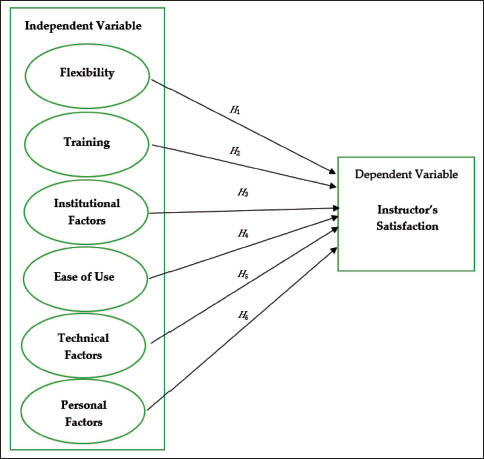
H1: The satisfaction of academics is not dependent on flexibility.
H2: The satisfaction of academics is not dependent on training.
H3: The satisfaction of academics is not dependent on institutional factors.
H4: The satisfaction of academics is not dependent on ease of use.
H5: The satisfaction of academics is not dependent on technical factors.
H6: The satisfaction of academics is not dependent on personal/psychological factors.
Figure 1. Conceptual Framework.
Methodology
The study was conducted by surveying more than 500 faculty members of various colleges and universities of Maharashtra and Madhya Pradesh who had taught at least one course online during the COVID-19 pandemic, out of which 300 respondents provided complete information. The survey was conducted via Google forms using questionnaire technique.
The questionnaire had total 36 question including 26 questions with 5-point Likert scale ranging from 1 strongly disagree to 5 strongly agree. The questions were based on the results of the literature review (Bolliger et al., 2014; Stickney et al., 2019), which included studies containing factors (flexibility, training factors, institutional factors, ease of use, technical factors and personal/psychological factors) influencing instructor’s satisfaction with online teaching. Respectively 3, 4, 4, 5, 5 and 5 items were created based on the construct from the literature. In order to determine the factors influencing satisfaction of the instructor regression analysis was used as it was used in previous research works also (Barbera et al., 2013; Stickney et al., 2019). Figure 1 explains about the independent and dependent variables used in the model.
In order to determine the internal reliability of the questionnaire, reliability analysis with the use of Cronbach’s alpha was performed after the data collection phase.
Results
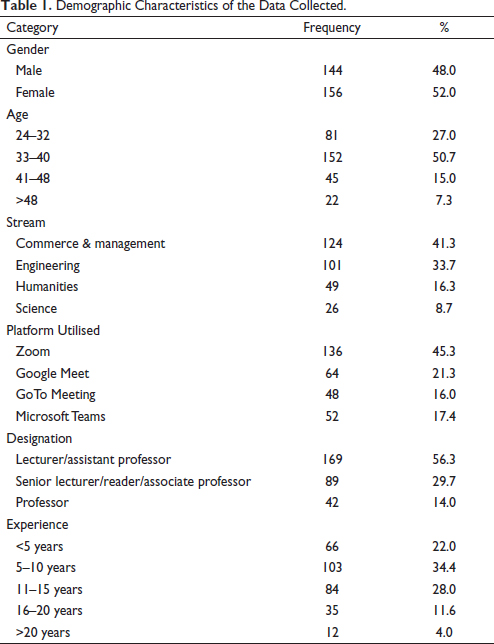
From Table 1, it can been seen that the demographics demonstrate that nearly half of the faculties are between 33 and 40 years of age, followed by faculties in the age group of 24 and 32 years. Demographics further demonstrate that more than half of the professors/teachers fall into the Lecturer/Assistant Professor category. The demographics suggest that more than 80% of the professors have experience of less than 15 years.
Figure 2. Stream.
.jpg)
Figure 3. Platform Utilised.
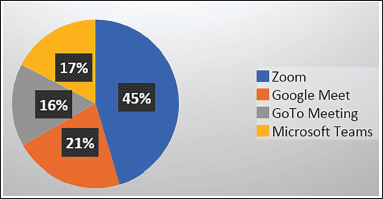
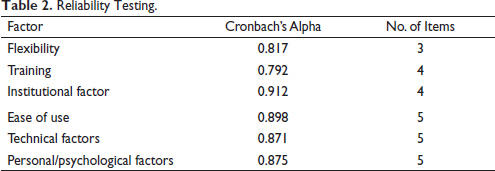
Figure 2 demonstrates that only 25% teachers are in the Humanities & Science streams, with the remaining falling in the Engineering & Commerce streams.
Figure 3 demonstrates the demographics relating to platforms utilised for online instruction. Zoom is the most widely used medium followed by Google Meet with GoTo Meeting being the least utilised medium.
In order to determine the questionnaire’s internal consistency reliability, Cronbach’s alpha coefficient was calculated. From Table 2, it can be observed that the value of Cronbach’s alpha is more than 0.79 for all the factors indicating a high level of internal consistency in the questionnaire.
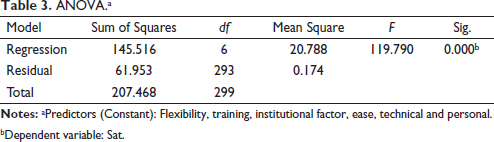
From Table 3 below, it can be observed that the F value is significant as the significance value is 0.000 which is less than 0.05, which means that all the factors jointly affect our dependent variable, that is, the satisfaction level of the academics.
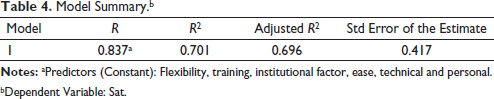
From Table 4, it can be observed the value of R2 0.701; it indicates that the proportion of the variance in satisfaction is explained 70% by the independent factors taken into this study, that is, flexibility, training, institutional factors, ease of use, technological factors and personal/psychological factors; it also suggest that the model is fitted rightly.
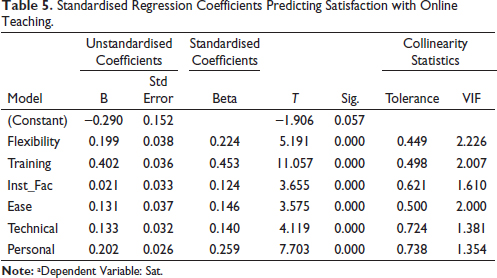
A test for collinearity was conducted by calculating the variance inflation factor (VIF) for each predictor and it can be observed from Table 5 that VIF scores were below the threshold of 5, indicating that collinearity was not a concern in this model (Hair et al., 2010). From Table 5, it can be observed that the β values of flexibility, training, institutional factors, ease, technical and personal are 0.199, 0.402, 0.021, 0.131, 0.133 and 0.202, respectively. The significance value for all the factors is 0.000, which is less than the 0.01 level of significance, signifying that all the hypotheses H1, H2, H3, H4, H5 and H6 are rejected. So, it can be concluded that satisfaction of academics is dependent on flexibility, training, institutional factors, ease of use, technical factors and personal/psychological factors.
Figure 4. Normal P–P Plot.
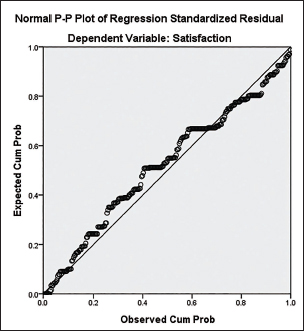
Based on the normal P–P Plot in Figure 4, it can be seen that the existing points follow and approach the diagonal line. Thus, it can be concluded that the residual value is normally distributed and regression analysis procedure has been fulfilled.
Discussion
While the world is in turmoil because of the aforementioned pandemic, the online education sector witnesses its golden age with a never seen before number of students and teachers adopting them out of dire necessity to complete the academic term, if nothing else. While the delivery mediums have existed for a long time, it is for the first time that they witness such a surge of users, a paradigm shift so large that it could be compared to the smartphone revolution of the early 2010. Inspired by this, the following study was conducted to delve into and analyse the impact of several variables on the satisfaction level of the faculties conducting the sessions, to determine a data-driven approach for smoother functioning of classes. The variables considered include flexibility, training factors and institutional factors, ease of use, technical factors and personal/psychological factors.
The study investigates factors influencing instructor satisfaction in virtual learning environments, considering various dimensions. First, flexibility emerges as a crucial factor, with higher satisfaction among faculty perceiving online mediums as conducive to flexible scheduling. However, challenges such as increased workload and frustration are noted, emphasising the need for balanced engagement. Training is identified as essential, impacting satisfaction levels. Adequate training in online teaching positively correlates with higher instructor satisfaction, aligning with previous studies. Institutional factors, encompassing support and policies, significantly affect faculty satisfaction, urging institutions to provide better support. Ease of use of online platforms is subjective but crucial; faculty members who find platforms easy to use report higher satisfaction. Technical factors, including reliable internet and equipment, directly impact satisfaction, requiring institutions to ensure accessibility. Finally, personal/psychological factors, such as comfort with online teaching and home-based work, influence satisfaction levels. The study underscores the importance of addressing these factors for effective virtual education, offering insights for institutions and policymakers.
Conclusion
The purpose of this research was to determine the factors influencing satisfaction of the instructor in VLE. Even though the research was exploratory in nature, it examined 300 instructors and professors, in different career paths and across multiple institutions of higher education from Maharashtra and Madhya Pradesh and across multiple disciplinary areas. For the purpose of the study, the questionnaire was developed based on previous research and instruments (Bolliger et al., 2014; Stickney et al., 2019). The study was conducted by using regression analysis as used in previous research works (Barbera et al., 2013; Stickney et al., 2019) in order to determine the factors influencing satisfaction of the instructor. The findings indicate that flexibility, training factors, institutional factors, ease of use, technical factors and personal/psychological factors significantly affect the satisfaction level of the instructors.
Scope for Future Research
This article mainly covers satisfaction levels of the faculties of HEIs due to challenges and benefits during the COVID-19 outbreak. However, due to the resources and time constraint, the research related to the viewpoint of students, administrators and academic institutions will be undertaken as part of near-future work. The comparative analysis of Google Meet, Zoom, Microsoft Teams, Webex and GoToMeeting could be the other area, the research of which will assist the users in deciding the usage of a particular platform. Besides the receptivity, apprehensions and adaptability of full-time faculty members versus the receptivity of part-time or visiting faculty members is an area that will be addressed. Cell phone usage is becoming an important part of everyone’s daily life and hence the m-learning platforms provided by technology companies will play a major role in learning and teaching practices. Therefore, comfort level and perceptions of all the stakeholders to adopt m-learning along with e-learning must also be investigated comprehensively.
Declaration of Conflicting Interests
The authors declared no potential conflicts of interest with respect to the research, authorship and/or publication of this article.
Funding
The authors received no financial support for the research, authorship and/or publication of this article.
Note
1. Global Online Education Market—Forecasts from 2020 to 2025.
ORCID iD
Saurabh Singh https://orcid.org/0000-0002-9554-7863
Almarashdeh, I., & Alsmadi, M. (2016). Investigating the acceptance of technology in distance learning program [Conference session]. 2016 International Conference on Information Science and Communications Technologies, ICISCT 2016. Institute of Electrical and Electronics Engineers Inc. https://doi.org/10.1109/ICISCT.2016.7777404
Arbaugh, J. B. (2000). Virtual classroom characteristics and student satisfaction with Internet-based MBA courses. Journal of Management Education, 24(1), 32–54. https://doi.org/10.1177/105256290002400104
Barbera, E., Raffaghelli, J. E., & Thamarai, R. (2013). Factors influencing student satisfaction and perceived learning in online courses. E-Learning and Digital Media, 10(3), 226–235. https://doi.org/10.2304/elea.2013.10.3.226
Blackmon, S. J. (2016). Teaching online, challenges and motivations: A research synthesis. Education Matters: The Journal of Teaching and Learning, 4(1). https://journalhosting.ucalgary.ca/index.php/em/article/view/62984
Bolliger, D. U., & Wasilik, O. (2009). Factors influencing faculty satisfaction with online teaching and learning in higher education. Distance Education, 30(1), 103–116. https://doi.org/10.1080/01587910902845949
Bolliger, D. U., Inan, F. A., & Wasilik, O. (2014). Development and validation of the online instructor satisfaction measure (OISM). Journal of Educational Technology & Society, 17(2), 183–195.
Chapman, D. D. (2011). Contingent and tenured/tenure-track faculty: Motivations and incentives to teach distance education courses. Online Journal of Distance Learning Administration, 14(3). https://www.westga.edu/~distance/ojdla/fall143/chapman143.html
Chen, K. Z., Lowenthal, P. R., Bauer, C., Heaps, A., & Nielsen, C. (2017). Moving beyond smile sheets: A case study on the evaluation and iterative improvement of an online faculty development program. Online Learning Journal, 21(1), 85–111. https://doi.org/10.24059/olj.v21i1.810
Davis, F. D. (1989). Perceived usefulness, perceived ease of use, and user acceptance of information technology. MIS Quarterly: Management Information Systems, 13(3), 319–339. https://doi.org/10.2307/249008
Dieli, A. L. (2020). Success stories: Community college teachers using technology to engage online students [Walden dissertations and doctoral studies]. https://search.proquest.com/docview/2377704789/?pq-origsite=primo
Eom, S. B., & Ashill, N. (2016). The determinants of students’ perceived learning outcomes and satisfaction in university online education: An update. Decision Sciences Journal of Innovative Education, 14(2), 185–215. https://doi.org/10.1111/dsji.12097
Gay, G. H. E. (2016). An assessment of online instructor e-learning readiness before, during, and after course delivery. Journal of Computing in Higher Education, 28(2), 199–220. https://doi.org/10.1007/s12528-016-9115-z
Georgina, D. A., & Hosford, C. C. (2009). Higher education faculty perceptions on technology integration and training. Teaching and Teacher Education, 25(5), 690–696. https://doi.org/10.1016/j.tate.2008.11.004
Golden, J. E. (2016). Supporting online faculty through communities of practice: Finding the faculty voice. Innovations in Education and Teaching International, 53(1), 84–93. https://doi.org/10.1080/14703297.2014.910129
Gupta, M. M., Jankie, S., Pancholi, S. S., Talukdar, D., Sahu, P. K., & Sa, B. (2020). Asynchronous environment assessment: A pertinent option for medical and allied health profession education during the COVID-19 pandemic. Education Sciences, 10(12), 352. https://doi.org/10.3390/educsci10120352
Hair, J. F., Black, W. C., Babin, B. J., Anderson, R. E., & Tatham, R. L. (2010). Multivariate data analysis (7th ed.). Pearson.
Helms, S. A. (2014). Blended/hybrid courses: A review of the literature and recommendations for instructional designers and educators. Interactive Learning Environments, 22(6), 804–810. https://doi.org/10.1080/10494820.2012.745420
Kane, R. T., Shaw, M., Pang, S., Salley, W., & Snider, J. B. (2016). Faculty professional development and student satisfaction in online higher education. Online Journal of Distance Learning Administration, 19(2), 105–115.
Kim, K. J., & Bonk, C. J. (2006). The future of online teaching and learning in higher education. Educause Quarterly, 29(4), 22–30.
Larkin, I. M., Brantley-Dias, L., & Lokey-Vega, A. (2016). Job satisfaction, organizational commitment, and turnover intention of online teachers in the K-12 setting. Online Learning Journal, 20(3), 26–51. https://doi.org/10.24059/olj.v20i3.986
Martin, B. (2015). Successful implementation of TPACK in teacher preparation programs. International Journal on Integrating Technology in Education (IJITE), 4(1). https://doi.org/10.5121/ijite.2015.4102
Mayo, N. B., Kajs, L. T., & Tanguma, J. (2005). Longitudinal study of technology training to prepare future teachers. Educational Research Quarterly, 29(1), 3–15. https://eric.ed.gov/?id=EJ718118
Nair, I., &Mukunda Das, V. (2012). Using technology acceptance model to assess teachers’ attitude towards use of technology as teaching tool: A SEM approach. International Journal of Computer Applications, 42(2). https://doi.org/10.5120/5661-7691
Remuzzi, A., & Remuzzi, G. (2020). COVID-19 and Italy: What next? The Lancet, 395(10231), 1225–1228. https://doi.org/10.1016/S0140-6736(20)30627-9
Research and Markets. (2020). Global online education market—forecasts from 2020 to 2025. https://www.researchandmarkets.com/reports/4986759/global-online-education-market-forecasts-
Rohland-Heinrich, N. L. (2016). Transitioning from lectern to laptop: Faculty experiences in online instruction. EScholarship, 1–163. https://escholarship.org/uc/item/6gf0r497
Schrum, L. (1999). Technology professional development for teachers. Educational Technology Research and Development, 47(4), 83–90. https://doi.org/10.1007/BF02299599
Stickney, L. T., Bento, R. F., Aggarwal, A., & Adlakha, V. (2019). Online higher education: Faculty satisfaction and its antecedents. Journal of Management Education, 43(5), 509–542. https://doi.org/10.1177/1052562919845022
Terantino, J. (2020). Exploring factors that impact faculty decisions to teach languages online: Is it worth the individual return on investment? Online Journal of Distance Learning Administration, 23(1). http://www.westga.edu/~distance/ojdla/spring231/terantino231.html
Venkatesh, V., & Davis, F. (2000). A theoretical extension of the technology acceptance model: Four longitudinal field studies. Management Science, 46(2), 186–204. https://www.jstor.org/stable/2634758?seq=1
Whalley, B., France, D., Park, J., Mauchline, A., & Welsh, K. (2021). Towards flexible personalized learning and the future educational system in the fourth industrial revolution in the wake of COVID-19. Higher Education Pedagogies, 6(1), 79–99. https://doi.org/10.1080/23752696.2021.1883458
Wingo, N. P., Ivankova, N. V., & Moss, J. A. (2017). Faculty perceptions about teaching online: Exploring the literature using the technology acceptance model as an organizing framework. Online Learning, 21(1). https://doi.org/10.24059/olj.v21i1.761
Wire, B. (2020). Online education market in India worth INR 360 billion by 2024. https://www.businesswire.com/news/home/20200417005258/en/Online-Education-Market-in-India-Worth-INR-360-Billion-by-2024-Exhibiting-a-CAGR-of-43—ResearchAndMarkets.com
